Circular economy challenges classic business models: Ann Peeters gives her take on circularity
20/04/2023
In cooperation with the faculties of Law & Criminology, Economics & Business and Engineering & Industrial Engineering, the Post University Centre KU Leuven is launching two new postgraduate courses on circular economy in October 2023. To set the right accents in terms of content, we consulted key actors in the industry. Agoria, sector federation of technology companies with a strong leg up in sustainable entrepreneurship, is one of those actors. At Agoria, Ann Peeters focuses on sustainability. She has seen first-hand how sustainable business models can promote economic growth and a healthier environment.
Circular economy: the pathway to sustainability
Ann Peeters works at Agoria's study department, where she focuses on sustainability. As part of the programme committee for the postgraduate programme Circular Economy – Business and legal frameworks and opportunities, she supervises and guarantees the qualitative, scientific and practice-oriented nature of the programme. Last year, Ann Peeters released a first sustainability report. "As sector federation, we were not the first to publish a report," she says. "But as an industry, we immediately made commitments and took concrete steps towards a more sustainable future.”
"One of the 12 impact domains of our sustainability path that we committed to is circular economy," Ann Peeters explains. "For us, this is an important domain where we already have great examples. Yet the number of companies that have already committed to implementing circular economy - i.e. life-extending and as-a-service projects - is rather limited. Changing that is a priority for us given, among other things, the increasingly difficult access to raw materials we have every interest in reusing. But it is also consumers who are demanding efforts, they are starting to take a stand against the throwaway culture.”
Circular (r)evolution
According to Ann Peeters, we are evolving towards completely different business models. "Today, our economy consists of you buying something, using it and then throwing it away. New business models will emerge and one that already exists today is the as-a-service model."
In the as-a-service model, the consumer is not buying a product but a service. For example: instead of buying a car, you sign a contract for transport. The distributor makes sure you always have a means of transport. This could be a small car if you are often driving in the city centre, but a big car when you leave on holiday. You buy a transport subscription (a service) rather than a car (product).
Legislation as a driving force
Those business models are very disruptive to how our economy works nowadays and breaking out of traditional models is not obvious. It is changing something fundamentally and humans are naturally averse to change. Agoria therefore tries to highlight as many examples and success stories as possible. And something that will of course accelerate this change is the European Green Deal, where circular economy plays an important part.
"Circular economy plays an important part in the Green Deal. As soon as there is clear legislation, such as the Corporate Sustainability Reporting Directive (CSRD), companies will switch gears. Something has been set in motion by Europe that is now gaining momentum, and it will hit companies at high speed.”
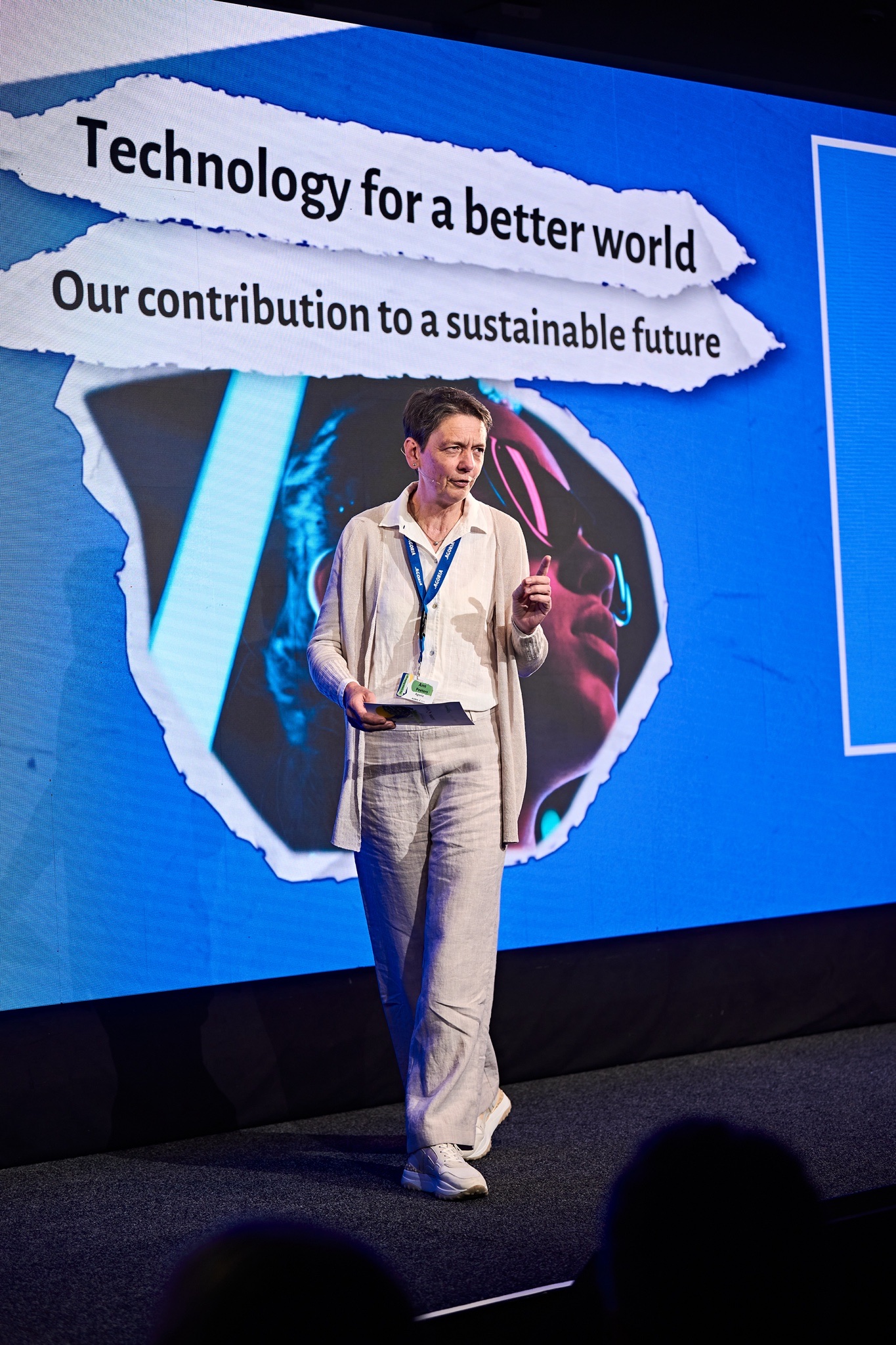
Ann Peeters, project leader studies centre Agoria
This programme runs jointly with the postgraduate programme Sustainable polymers in a circular economy.
Circularity as a solution for raw material dependency
Europe depends on other countries for a lot of raw materials. As soon as conflicts, monopolies or resource shortages arise, Europe gets into trouble. But we might have a solution at hand: "What we do have in Europe is an enormous amount of appliances, computers, cars, you name it. They all contain raw materials, albeit processed, we do have them. Today, we ship our old cars abroad to be given a new life or to be recycled. We might as well keep those cars in Europe and see how we could give them a second life or extract the raw materials."
If we move away from the linear model of working - take-make-dispose - then we need to think about a different model. We will need to start thinking ahead when designing products. The design should be intelligent in a way that it is easy to put together, but also easy to take apart.
Prep for progress: future-proof your life
For both Agoria and Ann lifelong learning is crucial. The (economic) environment and legislation are changing too rapidly to do anything but permanently upskill, reskill, and learn in general.
"Circularity has been around for years, but as more companies are only now having to implement it, many are not yet familiar with it," says Ann Peeters. "It's just essential: it's part of the European Green Deal, it's a model that companies need to move towards anyway and there is currently too little knowledge of it. Moreover, companies today are already terribly busy with their usual business. If knowledge on circularity is neatly framed in a course like Circular Economy: Business and legal frameworks and opportunities, that is ever so important. It is fantastic.
Want to know more about the postgraduate programme?
Find more information on the website or contact programme coordinator Céline Platteau.
Want to know more about the postgraduate certificate Circular Economy: Business and legal frameworks and opportunities
This programme allows you to acquire solid academic and applied interdisciplinary knowledge in the different strategies and models to establish and implement a circular business model, the associated economic, legal, political and social opportunities and challenges, as well as an introduction to recent developments in sustainable/circular materials and products.
Read more about the programme or contact programme coordinator Céline Platteau.
Gerelateerde opleidingen